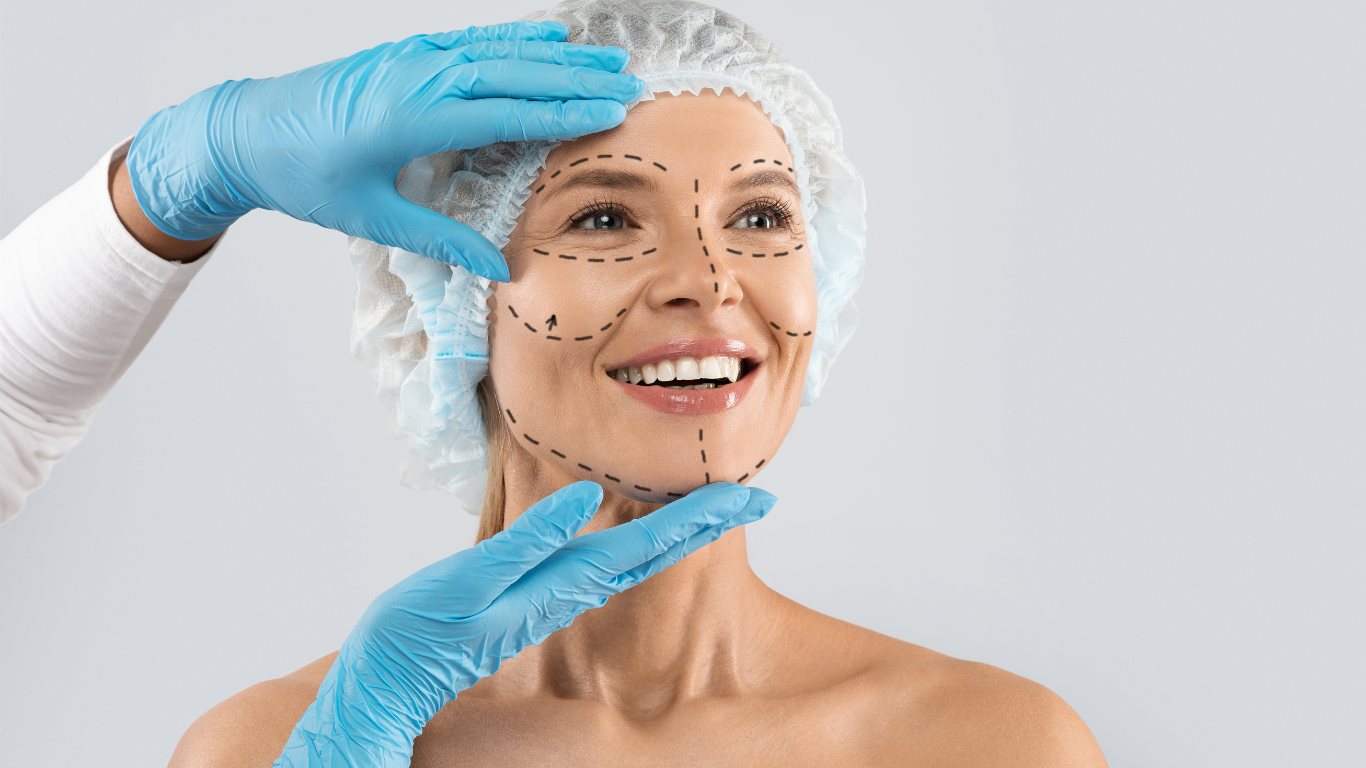
Blepharoplasty with facelifting: achieving harmony and natural rejuvenation
How to combine blepharoplasty with a face-lift achieves balanced, natural and long-lasting rejuvenation. Learn about benefits, techniques, candidates and Dr. Richer's comprehensive vision for true facial harmony.
Facial aging is a complex process that never affects a single area. The eyelids become heavy, the skin loses tension, the cheeks descend and the neck loses definition.
When only one area is addressed, the outcome risks appearing incomplete. Therefore, the strategic combination of blepharoplasty and facelifting has become one of the most effective ways to achieve natural, balanced and long-lasting rejuvenation.
This approach is a fundamental part of the philosophy of Dr. Richer, a facelifting specialist renowned for his precision, honesty and global aesthetic vision. He doesn't perform procedures because they are trending, nor does he follow the logic of maximizing benefits by number of surgeries.
Its priority is to deliver a complete result that respects the anatomy, preserves the patient's identity and remains faithful to the harmony of the face.
The importance of combining blepharoplasty and facelifting
The integration of these two procedures stems from a clear premise: the gaze leads the expression. If the eyes continue to look tired, even the most sophisticated lift feels incomplete. And if the eyelids look rejuvenated, but the rest of the face remains droopy, the contrast becomes evident.
The combination resolves this imbalance, creating a uniform result. While the lift repositions the deep tissues of the middle and lower third, blepharoplasty refines the eyelids and restores freshness to the emotional center of the face. Together, they increase the result without the need for overcorrection or drastic changes.
The objective is clear: harmony. Nothing should stand out too much, and nothing should be left behind.
How does blepharoplasty contribute to a facelift?
Blepharoplasty provides millimetric precision to global facial rejuvenation. Although the lift corrects deep structures and redefines contours, it does not remove excess skin on the eyelids or soften oily pockets. This is where blepharoplasty plays an essential role.
Upper blepharoplasty: restoring openness and lightness
In the upper eyelid, sagging can cause shadows, feelings of tiredness and even affect the visual field. Upper blepharoplasty removes excess skin and redistributes fat to recover the eye's natural curvature. When combined with a facelift, the eyelid opening is better integrated with restored tension in the cheeks and temples, avoiding the “renewed here but not there” look.
Lower blepharoplasty: soften bags and refine the look
Bags under the eyes are due to the displacement or herniation of fat. They don't go away with massages, creams or facelifts. Lower blepharoplasty allows fat to be repositioned to smooth the transition between eyelid and cheek. When performed together with a lift, this area regains continuity: a more relaxed look is combined with a repositioned cheekbone, creating a youthful effect without stiffness or artificial changes.
Techniques used and their integration with facelifts
The ideal technique depends on each patient and the structure of their face. Dr. Richer selects the best option based on anatomical criteria, not commercial preferences.
Transconjunctival incision
It is ideal for younger patients or those with bags without excess skin. The incision is made inside the eyelid, so there is no visible external scar. When combined with a lift, it offers a soft and very natural finish in the infraorbital region.
Traditional blepharoplasty with external incision
It is used when it is necessary to remove skin, tighten the muscle or adjust both volume and structure. The scar lies just below the lash line and, with careful technique, becomes practically imperceptible.
Synergy with deep plane lifting
The Deep Plane Facelift, a technique that Dr. Richer has mastered with excellence, repositions the deep layers of the face without creating artificial surface tension. When integrated with blepharoplasty, both procedures work in a coherent way: one supports and structures, the other refines and frames the look. The result is more stable, more natural and more durable.
Ideal candidates for this combination
Not all patients need both surgeries, and that honesty is part of Dr. Richer's seal. A good candidate usually has flaccidity in the middle and lower third, loss of definition in the neck and jaw, and obvious signs of aging in the eyelids. These changes usually appear between the ages of 40 and 70, although the actual age is not as important as the state of the tissues.
The patient must also be in good general health, not smoking or commit to stopping smoking before surgery, and have realistic expectations. The most important thing is to understand that the goal is not to change the face, but to return it to its original harmony.
The procedure: how are the two surgeries integrated?
The surgery begins with detailed planning. Dr. Richer evaluates facial proportions, bone structure, skin quality, and the natural interaction of the eyelids with the cheeks.
His approach is to perform both interventions during the same surgical session whenever it is safe, avoiding multiple exposures to anesthesia and accelerating overall recovery.
First, the deep structure is addressed by lifting. This ensures that the tension applied to the tissues is internal and does not alter the shape of the eye. Then, with the base already harmonized, Dr. Richer perfects the eye region by performing blepharoplasty. This sequence prevents overcorrection and generates a balanced finish.
Recovery: What to Expect When Combining Blepharoplasty and Lifting
The combined recovery is usually not much more extensive than that of a lift performed alone. Most patients have swelling, bruising and a feeling of tightness around the eyelids, which decreases markedly during the first week. Keeping your head elevated, using cold compresses and following post-operative instructions carefully is essential.
Although many patients can resume light activities within two weeks, the complete process of deinflammation and tissue maturation continues for several months. The final result is seen between the third and sixth month, when the face takes on a completely natural appearance and the look is integrated with the new facial structure.
Long-term results: naturalness, balance and durability
The combination of lifting and blepharoplasty provides results that can be maintained for 10 to 15 years. The reason is clear: by repositioning deep tissues, tightening muscle structures and refining the gaze, we act directly on the causes of aging, not just on its visible effects.
It's important to note that the results don't stop with surgery. Lifestyle, aftercare and sun protection greatly influence the longevity of rejuvenation. Dr. Richer's patients often notice that their appearance stays fresh for years thanks to a precisely corrected anatomical base.
Dr. Richer's Approach: Ethics, Harmony, and Technical Excellence
In addition to his surgical skill, Dr. Richer stands out for his professional ethics. It does not operate to those who are not candidates, it does not recommend unnecessary interventions and it does not commit to results that it considers artificial or unrealistic. Their goal is always to create harmonious faces, not altered versions of the patient's identity.
FAQs
Is it better to have a blepharoplasty or a lift first?
The ideal is to perform both procedures in the same surgery if the patient needs it. This integration allows for more natural results and avoids disproportionate tensions between different areas of the face.
Does the combination increase recovery time?
Recovery is usually not significantly prolonged. Swelling in the eyelids is most evident during the first few days, but the overall rest time is similar to that of a lift alone.
Does blepharoplasty change the shape of the eye?
No. A well-performed technique respects the patient's original anatomy. The goal is to rejuvenate, not to change expression or facial identity.
Do the results look natural?
Yes. By integrating both procedures, the transitions between the eyelids, cheeks and jaw are smoothed, achieving a balanced and authentic appearance, far from the “operated” aspect.
The Power of Comprehensive Rejuvenation
The combination of blepharoplasty and facelifting represents one of the most comprehensive and effective approaches to achieving authentic rejuvenation. When both surgeries are precisely integrated, the face regains harmony, the look becomes fresher and the facial contours regain definition without losing naturalness.
For the Dr. Richer, this balance is not a side effect: it is the main goal. Its philosophy, based on honesty, artistic vision and deep respect for the patient's anatomy, ensures that each intervention is performed with a clear purpose and a standard of excellence. It's not about changing the face, but about restoring its best version, in a safe, ethical and aesthetically coherent way.
When the right technique is combined with an integral approach and honest judgment, the result transcends aesthetics: the patient regains confidence, projection and an expression that feels like his own. In expert hands, the union between Eyelid surgery and facelifting is one of the most powerful tools for rejuvenating without losing identity.
